
10 Essential Export Documents Every Indian Exporter Should Know
Introduction
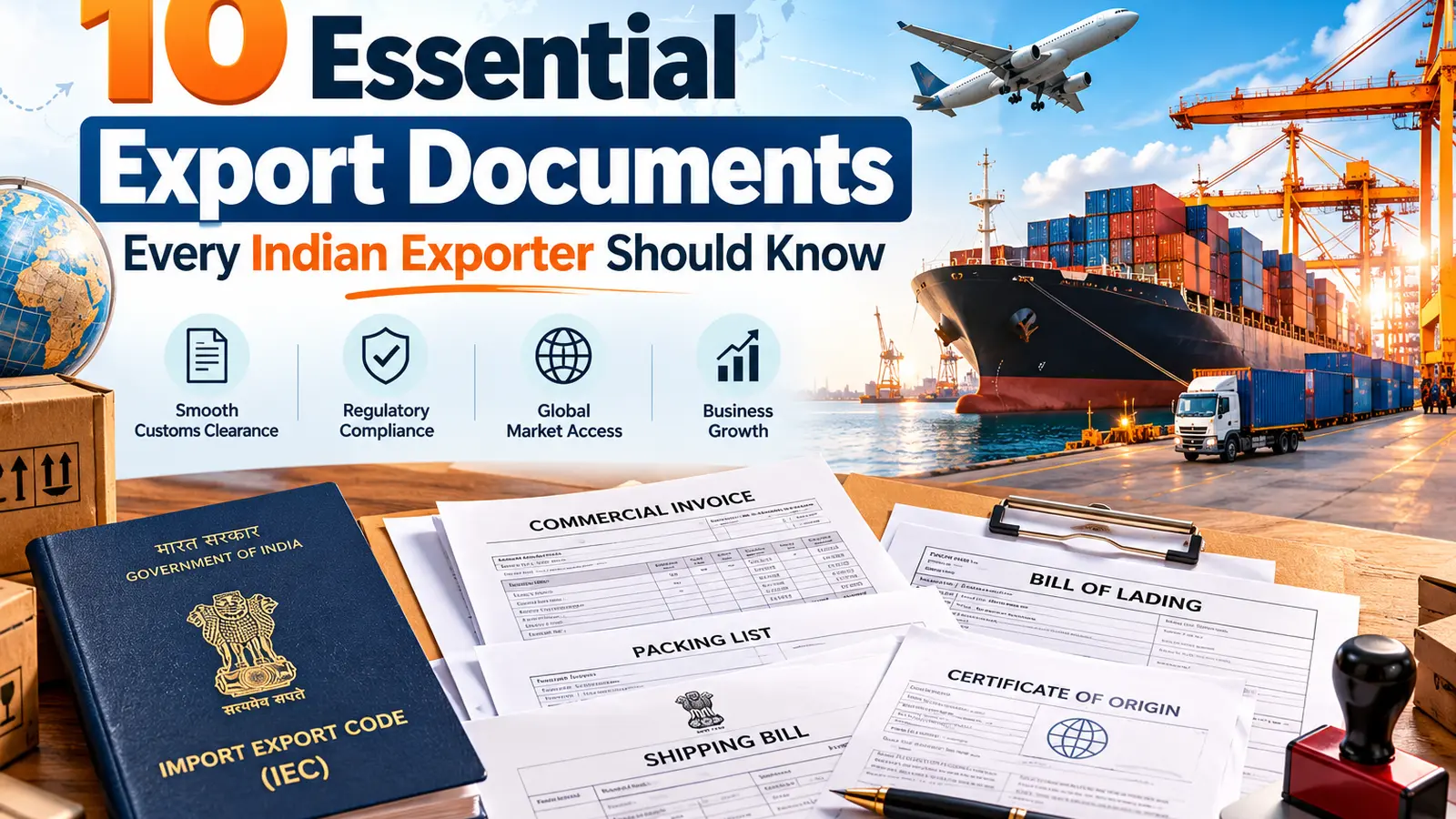
Exporting goods from India to international markets offers businesses excellent opportunities to expand their customer base and increase revenue. However, successful exporting requires proper documentation to ensure smooth customs clearance, regulatory compliance, and timely delivery of goods. Understanding the export documents required in India is essential for manufacturers, traders, small businesses, and first-time exporters.
Export documentation helps customs authorities verify shipments, enables buyers and sellers to complete transactions, and supports the transportation of goods across international borders. Missing or incorrect documents can lead to shipment delays, additional costs, and customs complications.
In this guide, we will explain 10 essential export documents that every Indian exporter should know before shipping products internationally.
1. Importer Exporter Code (IEC)
The Importer Exporter Code (IEC) is a key registration requirement for businesses involved in importing or exporting goods from India. It is issued by the Directorate General of Foreign Trade (DGFT).
Exporters generally need an IEC to clear customs and conduct export transactions, subject to applicable exemptions and specific regulatory provisions. Businesses should ensure that their IEC details are accurate and comply with current DGFT requirements.
2. Commercial Invoice
A commercial invoice is one of the most important documents in international trade. It is issued by the exporter to the overseas buyer and contains essential transaction details.
A commercial invoice typically includes:
-
Exporter and buyer details
-
Product descriptions and quantities
-
Unit prices and total invoice value
-
Currency and payment terms
-
Country of origin, where required
-
Shipping and delivery terms
Customs authorities may use the invoice to assess the value of exported goods and verify shipment information.
3. Packing List
A packing list provides detailed information about how products are packed for shipment. It helps customs officials, freight forwarders, and buyers identify and verify the contents of a consignment.
The document generally includes the number of packages, product descriptions, net and gross weights, dimensions, and packaging details. Accurate packing information helps reduce discrepancies during cargo inspection and transportation.
4. Shipping Bill
A shipping bill is a principal customs document used for exporting goods from India. It is filed electronically through the applicable Indian Customs system, generally by the exporter or an authorised customs broker.
The shipping bill contains shipment details, product classification, declared value, and other information required for customs processing. Customs authorities use it to assess the export declaration and determine whether the goods can be cleared for export.
Exporters should ensure that the information in the shipping bill matches the commercial invoice, packing list, and other relevant records.
5. Bill of Lading or Airway Bill
A Bill of Lading (B/L) or Airway Bill (AWB) is a transportation document issued by the carrier or its authorised agent.
-
Bill of Lading: Generally used for sea freight.
-
Airway Bill: Used for air freight.
These documents provide shipment details, identify the shipper and consignee, and confirm that goods have been received for transportation. A Bill of Lading may also serve as a document of title, depending on its type, while an Airway Bill generally does not.
Choosing the correct transport document is an important part of preparing the export documents required in India.
6. Certificate of Origin
A Certificate of Origin (CoO) certifies the country where the exported goods originate. Overseas buyers or customs authorities may require it to determine applicable import duties and verify compliance with trade agreements.
There are two common types:
-
Preferential Certificate of Origin: Used when goods qualify for preferential tariff treatment under an applicable trade agreement.
-
Non-Preferential Certificate of Origin: Establishes the origin of goods without claiming preferential tariff benefits.
The appropriate certificate depends on the destination country, product, and applicable trade agreement. Exporters can check the official DGFT Certificate of Origin platform for the relevant process.
7. Proforma Invoice
A proforma invoice is a preliminary document sent to a potential buyer before the final commercial invoice is issued. It outlines the proposed transaction and helps both parties confirm the terms of the order.
It commonly includes product details, estimated prices, quantities, delivery terms, payment conditions, and the expected shipment schedule.
A proforma invoice is particularly useful when the buyer needs a quotation or must arrange advance payment. It is not a substitute for the final commercial invoice.
8. Purchase Order or Export Order
A purchase order is a document issued by the buyer confirming the products or services they intend to purchase from the exporter.
It typically specifies product quantities, agreed prices, delivery timelines, payment terms, packaging requirements, and other conditions.
Exporters should review the purchase order carefully before accepting it. The details should match the agreed quotation and subsequent commercial documents to minimise disputes and shipment errors.
9. Insurance Certificate
An insurance certificate provides evidence of cargo insurance when coverage has been arranged for an international shipment.
Goods transported by sea, air, or land may face risks such as accidental damage, loss, or other covered events. Cargo insurance can help protect the financial interests of the exporter or importer, depending on the policy and contractual terms.
Whether insurance is required depends on the sales agreement, delivery terms, buyer requirements, and applicable rules. Exporters should check who is responsible for arranging coverage before dispatch.
10. Inspection Certificate and Product-Specific Certificates
Some products and destination markets require inspection certificates, quality certificates, health certificates, or other regulatory documents.
For example, food and agricultural products may require specific certificates from the relevant Indian authorities. Other products may need testing reports, conformity documents, or licences, depending on the product and destination.
Exporters should verify the requirements before shipping goods to avoid customs delays, rejection, or additional compliance costs.
Why Is Accurate Export Documentation Important?
Preparing the correct export documentation helps businesses:
-
Complete customs clearance efficiently.
-
Meet applicable Indian export regulations.
-
Reduce the risk of documentation errors and shipment delays.
-
Provide accurate information to international buyers.
-
Support payment processing and maintain transaction records.
-
Meet destination-country requirements.
Although the ten documents above are commonly used in export transactions, not every document is mandatory for every shipment. India’s core mandatory export documents generally include the applicable transport document, commercial invoice-cum-packing list, and shipping bill or bill of export. Additional documents depend on the product, destination, transport method, trade agreement, and regulatory requirements.
How Globus Certify Can Help with Export Documentation
Preparing export paperwork can be challenging, particularly for businesses entering international markets for the first time. Understanding the documentation process and applicable compliance requirements can help exporters avoid preventable mistakes.
Globus Certify offers export documentation services to support businesses with their documentation needs. Exporters can explore the service to understand the assistance available for preparing and managing export-related paperwork.
Learn more about the service: Export Documentation Services – Globus Certify
Conclusion
Understanding the export documents required in India is an important step towards building a smooth and compliant export operation. From the IEC and commercial invoice to the shipping bill, transport documents, and product-specific certificates, each document serves a distinct purpose in international trade.
Before dispatching goods, exporters should verify the current requirements with the relevant authorities, customs broker, freight forwarder, and overseas buyer. Proper preparation can help minimise delays, improve coordination, and support successful international shipments.
With suitable documentation support and careful planning, Indian businesses can manage export procedures more confidently and focus on expanding into global market