
FDA Facility Registration: Do You Need an FEI Number Before Exporting?
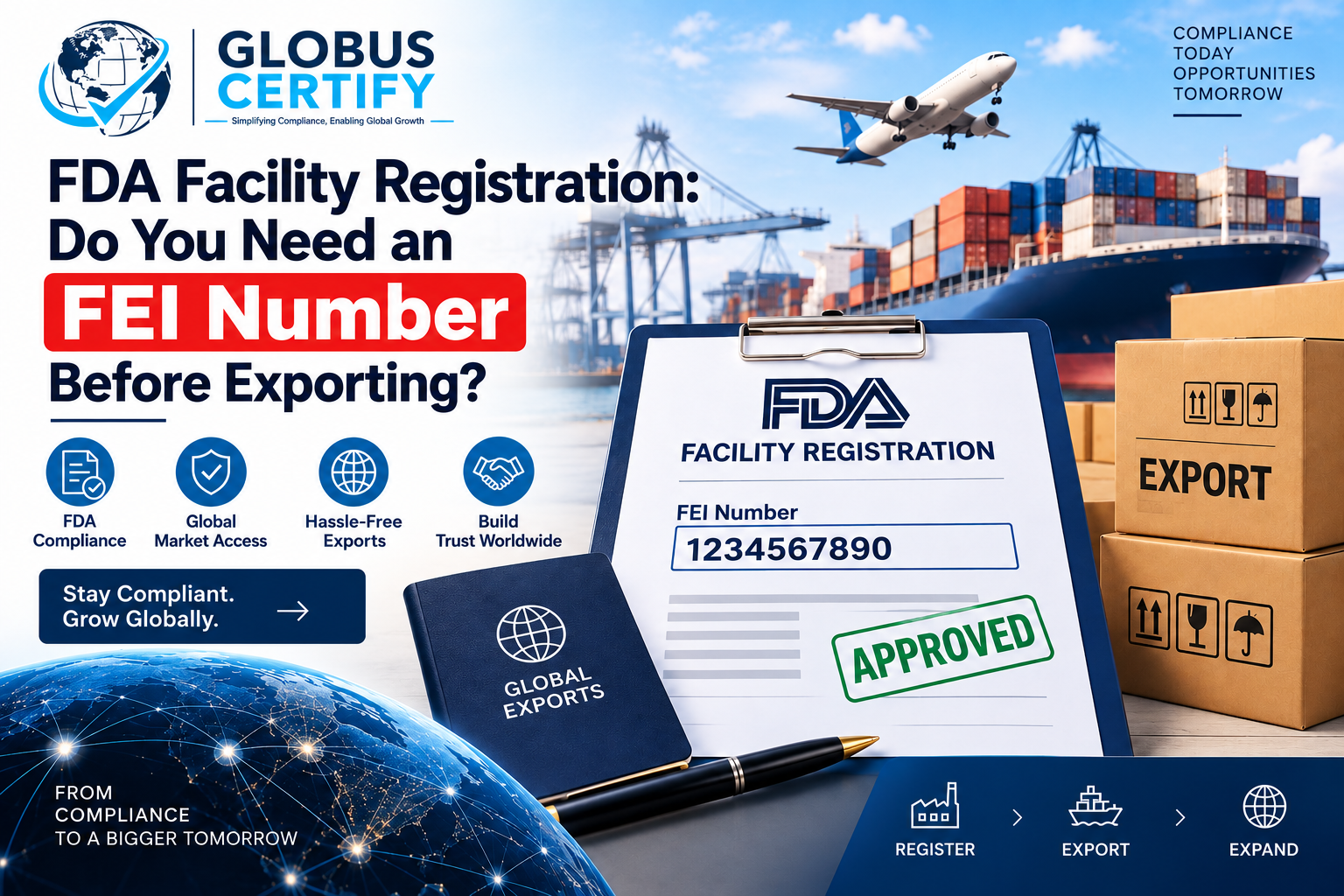
Quick Answer: Yes. If your facility manufactures, processes, packs, or holds FDA-regulated food, dietary supplement, or cosmetic products intended for the U.S. market, you must complete FDA Facility Registration and obtain an FEI (FDA Establishment Identifier) number before your first shipment leaves for the United States. Registering after the shipment has already left does not resolve a hold or detention — it must be done in advance.
Key Takeaways
- FDA Facility Registration is mandatory, not optional, for any domestic or foreign facility that manufactures, processes, packs, or holds FDA-regulated products for the U.S. market.
- An FEI number is the unique ID the FDA assigns to a registered facility, used on Prior Notice filings and import documentation.
- Registration and the FEI number must be in place before the first shipment — not arranged retroactively.
- Most facility registrations must be renewed every two years, during the October 1 – December 31 window.
- Foreign facilities must also designate a U.S. Agent as part of the registration process.
- Missing or incorrect FEI details are one of the most common, avoidable reasons shipments get held at U.S. ports.
If you’re planning to export food, dietary supplements, cosmetics, or other FDA-regulated products to the United States, this is a requirement you cannot skip. Many first-time exporters assume that having a good product and a buyer in the U.S. is enough — until their shipment gets held at the port because the facility wasn’t registered, or because the paperwork listed the wrong FEI number.
This guide breaks down what FDA Facility Registration actually means, when you need an FEI number, and how to avoid the compliance mistakes that delay shipments.
What Is FDA Facility Registration?
FDA Facility Registration is a mandatory process for any facility — domestic or foreign — that manufactures, processes, packs, or holds food, drugs, dietary supplements, or certain other regulated products intended for the U.S. market. The registration is submitted to the U.S. Food and Drug Administration (FDA) and confirms that a facility exists, is operating, and can be identified in the agency’s system.
Without a valid registration, food and beverage shipments can be refused entry at U.S. ports under the Federal Food, Drug, and Cosmetic Act. This applies even if your product itself meets every ingredient and labeling requirement.
Who Needs to Register?
You likely need FDA Facility Registration if your business:
- Manufactures or processes food products for export to the U.S.
- Packages or repackages food or supplements before export
- Operates a warehouse or storage facility that holds FDA-regulated goods destined for the U.S.
- Produces dietary supplements, certain cosmetics, or over-the-counter drug products
Foreign facilities are required to register just like U.S.-based ones, provided their products are intended for the American market. A common misconception is that only the exporter or importer needs to be registered — in reality, the manufacturing or processing facility itself must hold the registration.
What Is an FEI Number, and Why Does It Matter?
An FEI (FDA Establishment Identifier) number is a unique identifier the FDA assigns to a registered facility. Think of it as your facility’s ID card within the FDA’s system. Once your facility completes registration, the FDA issues this number, which is then used to:
- Link your facility to specific product listings
- Appear on import documentation and Prior Notice submissions
- Allow FDA and U.S. Customs and Border Protection (CBP) to verify your facility during import review
If your FEI number is missing, incorrect, or doesn’t match the registration on file, shipments can be flagged for review or detained — even when the product itself is fully compliant. This is one of the most common and avoidable reasons exporters face delays at U.S. ports.
When Do You Need the FEI Number Before Exporting?
You need a valid FEI number before your first shipment reaches U.S. customs. Specifically:
- Before submitting Prior Notice — food shipments require Prior Notice to the FDA before arrival, and this submission requires the facility’s FEI number.
- Before listing on import documentation — commercial invoices and entry filings for FDA-regulated goods typically reference the FEI number.
- Before working with a U.S. Agent — foreign facilities must designate a U.S. Agent as part of registration, and this step is tied to the FEI record.
Registering after a shipment has already left port is not a workaround — it typically results in the shipment being held, and in some cases, refused entry entirely.
How Do You Register Your Facility?
The registration process generally involves:
- Determine facility type — confirm whether your operation falls under food, dietary supplement, cosmetic, or drug facility registration rules, as each has slightly different requirements.
- Gather business details — legal facility name, physical address, business operations, and a Unique Facility Identifier (UFI), such as a DUNS number.
- Designate a U.S. Agent — foreign facilities must appoint a U.S.-based agent who can communicate with the FDA on the facility’s behalf.
- Submit registration — complete the registration through the FDA’s official system.
- Receive your FEI number — once processed, the FDA issues the unique identifier tied to your facility.
- Renew biennially — most facility registrations must be renewed every two years (during the October–December renewal window), or the registration is automatically cancelled.
What Mistakes Do Exporters Commonly Make?
- Assuming the importer’s registration covers the manufacturing facility (it doesn’t — each facility in the supply chain has separate obligations)
- Letting registration lapse during the renewal window without realizing it
- Using an outdated or incorrect FEI number on shipping documents
- Registering the wrong facility type, leading to rejected or incomplete filings
How Long Does FDA Facility Registration Take?
Processing times vary depending on facility type and how complete the submission is. In most cases, food facility registration through the FDA’s online portal is processed within a few business days once all required information is submitted correctly. However, delays are common when:
- The Unique Facility Identifier (UFI) or DUNS number is missing or invalid
- The U.S. Agent details are incomplete
- The facility type is misclassified during submission
Exporters should not assume same-day processing. It’s advisable to complete registration at least 3–4 weeks before your planned shipment date, especially if this is your facility’s first registration or if you’re also coordinating label review and Prior Notice filing at the same time.
What Happens If You Export Without Registration?
Shipping FDA-regulated products from an unregistered facility carries real financial and operational risk, including:
- Import refusal — CBP can refuse entry of the shipment at the port, sending it back or holding it in a bonded warehouse at your cost.
- Product destruction — in some cases, detained goods that cannot be brought into compliance are destroyed rather than returned.
- Demurrage and storage fees — every day a shipment sits at port waiting for documentation adds to your costs.
- Reputational damage with buyers — a delayed or rejected shipment can jeopardize your relationship with the U.S. importer or retailer, especially for time-sensitive food products.
- Increased scrutiny on future shipments — facilities with a history of compliance issues are more likely to be flagged for inspection going forward.
None of these outcomes are worth the relatively straightforward process of registering correctly the first time.
What’s the Difference Between Facility Registration and Product Listing?
Facility registration confirms that your manufacturing or processing site exists and is known to the FDA. Product listing (required for certain categories, such as drugs and some device categories) identifies the specific products made at that facility.
For most food and dietary supplement exporters, facility registration is the primary requirement — but it’s worth confirming with a regulatory consultant which obligations apply to your specific product category, since requirements differ across food, supplements, cosmetics, and drug products.
FDA Facility Registration Requirements by Product Category
| Product Category | Registration Type | Renewal Cycle | Additional Requirement |
| Food & Beverage | Food Facility Registration | Every 2 years (Oct–Dec) | Prior Notice for each shipment |
| Dietary Supplements | Food Facility Registration | Every 2 years (Oct–Dec) | NDI notification (if applicable) |
| Cosmetics | Cosmetic Product Facility Registration (under MoCRA) | Biennial | Product listing requirement |
| OTC Drugs | Drug Establishment Registration | Annual | Product listing (NDC required) |
This is a simplified overview — the exact obligations depend on your specific product formulation, packaging, and how the facility operates. Exporters handling multiple product lines (for example, a brand selling both food items and cosmetics) may need to register separately under different frameworks for the same physical facility.
Pre-Shipment Compliance Checklist
Before your first shipment leaves for the U.S., it’s worth running through this quick checklist:
- Facility registered under the correct product category
- Valid FEI number obtained and recorded
- UFI/DUNS number active and linked to registration
- U.S. Agent designated and contactable
- Registration renewal date tracked (not expiring mid-shipment)
- FEI number correctly listed on commercial invoice and Prior Notice
- Product labeling reviewed against FDA requirements
- Ingredient and formula compliance verified for the destination category
Missing even one of these can be enough to trigger a hold at the port — which is why most experienced exporters build this into their standard pre-shipment process rather than treating it as a one-time task.
How GlobusCertify Helps Exporters Get This Right
Facility registration sits at the intersection of documentation, regulatory classification, and ongoing compliance tracking — which is exactly where most first-time exporters lose time. GlobusCertify’s regulatory team works with businesses to:
- Determine the correct registration category for their product and facility
- Complete FDA Facility Registration and secure the FEI number
- Coordinate UFI/DUNS setup where it doesn’t already exist
- Act as or arrange a reliable U.S. Agent point of contact
- Track renewal timelines so registration never lapses unexpectedly
- Review Prior Notice and shipping documentation before it’s submitted
Instead of researching FDA requirements shipment by shipment, exporters get a structured process that’s set up once and maintained going forward.
Frequently Asked Questions
Is FDA Facility Registration a one-time process? No. Most facility registrations must be renewed every two years during the October 1 – December 31 renewal window. Missing this window can result in automatic cancellation of your registration.
Can one FEI number cover multiple facilities? No. Each physical facility location requires its own registration and receives its own unique FEI number, even if they’re owned by the same company.
Does a trading company or exporter need an FEI number, or only the manufacturer? The FEI number is tied to the facility that manufactures, processes, packs, or holds the product — not necessarily the exporter or trading company, unless that entity also performs one of those functions at its own location.
Do I need a U.S. Agent if my facility is outside the U.S.? Yes. Foreign facilities are required to designate a U.S. Agent as part of the registration process, who serves as the point of contact between the facility and the FDA.
What happens if my FEI number is entered incorrectly on shipping documents? Mismatched or incorrect FEI details can trigger a hold or review of the shipment, since FDA and CBP cross-check this information against the registration database during import screening.
Final Thoughts
FDA Facility Registration and your FEI number are foundational to exporting into the U.S. market — not paperwork you can handle after the fact. Getting this right before your first shipment protects you from costly delays, detentions, and rejected entries.
If you’re preparing to export food, supplements, or cosmetics to the U.S. and aren’t sure whether your facility needs registration — or which FEI details should appear on your documentation — GlobusCertify can help you assess your requirements and get compliant before you ship.